Field Sensing
Collect sunlight, temperature, wind, inverter and meter data.
Centralize generation, equipment and maintenance status across sites to inform daily management.
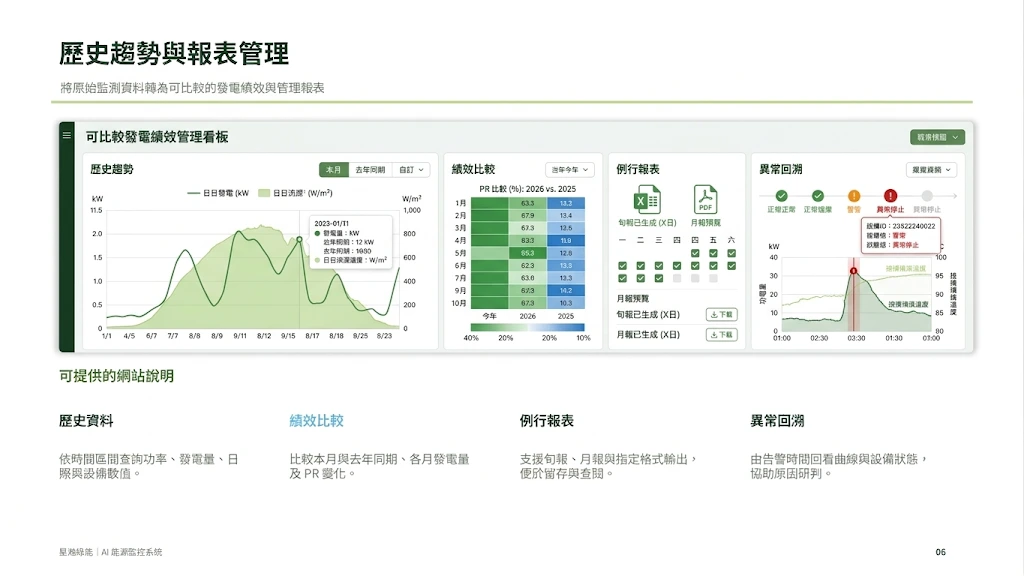
Combine solar, storage and consumption data for single- and multi-site management. Available functions depend on equipment brands, communications and data conditions.
Collect sunlight, temperature, wind, inverter and meter data.
Clean data, monitor communications and perform selected local assessments.
Present multi-site overviews, historical trends, alarms and reports.
Define integration scope around APIs, equipment interfaces and existing systems.
Review generation and equipment status, prioritizing sites that need attention.
Depending on data and models, help identify abnormal strings, suspected soiling or hot spots for on-site inspection.
Record alarm severity, assessment, dispatch and resolution to connect maintenance workflows.
Compare energy output, PR and historical baselines to trace abnormal periods.
Prepare ten-day, monthly and custom-format management reports as needed.
Assign access by user and site, retaining operation and response records.
| Metric | What You Can Track |
|---|---|
| Data Completeness | Missing or delayed data and communication outages |
| Equipment Availability | Normal operation and unplanned downtime |
| PR & Generation Deviation | Difference from expected performance or historical baselines |
| Alarm Response Time | Time from occurrence through assessment and dispatch to closure |
| Report Completion Rate | On-time delivery of required reports |
| Inspection Scope | Areas or equipment narrowed down by anomaly diagnostics |
Inventory equipment, points, brands, protocols and available data.
Define monitoring, alarms, reporting and API scope around management needs.
Check data completeness, alarm workflows, user permissions and reports.
Provide contracted maintenance and refine settings using actual data.
Start with your site's needs to determine equipment, configuration and integration.